
A Wisconsin Hitter's Winter Plan | BSG
Posted by Burghardt Sporting Goods on Sep 25th 2026
A Wisconsin Hitter's Winter Plan, November to Opening Day
Your season ended weeks ago and the next one is months out. Here is the winter plan in between.
Every fall we watch the same thing happen. The last tournament wraps up in October, the bat goes in the garage, and nobody thinks about hitting again until somebody mentions tryouts. Five months later that player picks the bat back up and it feels like a stranger's. Wisconsin gives you a long gap, and what you do with it is a choice worth making on purpose instead of by accident.
The gap nobody puts on the calendar
Youth and travel ball around Milwaukee finishes up in the fall. WIAA spring baseball practice does not open until late March, and in 2026 the earliest date was March 23. Do the arithmetic and you get about five months where nothing is scheduled, nothing is required, and no coach is checking. That is most of a year's development window sitting idle, right when the weather makes it easy to let it slide.
The good news is that you do not need much. A half hour a week, indoors, from December through February, is enough to arrive at that first March practice with a swing that already works.
What the winter looks like, month by month
Here is the rhythm we see work for hitters from Little League up through varsity.
November: rest, and mean it
Put the gear away. This is the month the arm is supposed to be doing nothing, and a player who has been throwing since March has earned it. Nothing is lost in four weeks off.
December: get back in once a week
Start easy. A couple of standard rounds at a comfortable speed, just making contact, is plenty for the first few visits. The goal in December is building the habit, not building the swing.
January: add a measured round
Once the swing feels normal again, finish a session in the HitTrax tunnel. Exit velocity in January gives you a number to compare against in March, which is more useful than anybody's memory of how it looked.
February: sort out the gear
Kids grow over the winter, often several inches without anyone noticing. February is when you find out whether last year's bat still fits, while there is still time to do something about it.
March: pick up the pace
Twice a week if you can manage it, at speeds closer to what the player will actually see. By the time practice opens, the first week is a tune-up instead of a reintroduction.
Please do not swing that bat in a cold garage
Bat makers warn against using composite barrels below roughly 60 degrees, and cold-weather damage is commonly excluded from warranty coverage. A frozen ball is a hard ball, and a hard ball in January is how a good bat ends up in two pieces. If the space is not heated, it is not the place.
What belongs in a winter plan, and what does not
Most of the difference between a winter that pays off and one that does not comes down to a handful of decisions made in November.
Do
- Pick one day of the week and keep it. Saturday morning beats "when we get around to it" every year.
- Give the throwing arm real months off while the hitting keeps going.
- Measure something in January so you can compare in March.
- Re-check bat length and weight before spring, not during it.
Skip
- The one giant February session that is supposed to make up for three empty months.
- Full-effort throwing programs squeezed in around the hitting.
- Cold-garage swings with a composite bat.
- Buying a new bat in March without the player having swung it first.
Thirty minutes a week for twelve weeks is a better winter than one heroic Saturday in February.
The growth spurt problem
This is the part that catches families off guard. A player who fit a 30-inch bat in September can be an inch and a half taller by March, and a bat that is now short and light produces a swing that looks fine and does nothing. Winter is when you catch that, because you are already in the building.
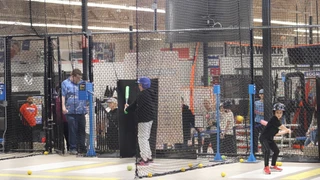
Inside our cages we run the Demo House, a free bat and helmet borrow station. Grab two or three demos, take real cuts with each one in a tunnel, and let the player tell you which one fits. Two bats with identical numbers on the spec sheet can feel completely different in a thirteen-year-old's hands. If you want the sizing logic first, our guide to choosing and sizing a youth baseball bat walks through length, weight, and drop.
How it works when you get here
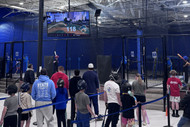
No appointment, no booking window, no app. The cages run on the BSG Cage Card system and they are walk-in, so you can come in any time we are open, which in winter means as late as 9 PM on weeknights. Load the card, pick a tunnel, swipe in.
What to bring on a winter cage night
- A loaded BSG Cage Card. Credits are $2 each, or 20 for $30, and they do not expire between visits.
- A helmet, or borrow one from the Demo House.
- Batting gloves, because hands get cold on the drive over.
- One thing to work on. A single focus beats a list of five.
You can load credits ahead of time on the Cage Credits page and pick the card up at the counter. For how to spend those rounds well once you are in the tunnel, we wrote a whole post on making cage time count.
If you are planning for a whole team
The cages handle individual hitters and small groups. A full roster needs room, and that is what the 7,500 square foot turf is for. Turf blocks are reservation-based rather than walk-in, and coaches usually lock in their winter dates well before January fills up. Our post on indoor turf and practice facility rental near Milwaukee covers how that side works.
Start the winter here
Four indoor tunnels, three standard and one HitTrax, walk-in all winter long. Stop in and we will get a card loaded and a player hitting.
15333 W National Avenue, New Berlin, WI 53151
Phone: (262) 790-1170
Hours: Mon–Fri 9 AM–9 PM, Sat 9 AM–7 PM, Sun 10 AM–6 PM
Wondering whether winter cage time is worth it in the first place? Our companion post answers that one directly: Why Should My Child Use an Indoor Batting Cage in Winter?
When you love baseball like we do, you can't beat Burghardt! Since 1881.