
How to Choose the Right Baseball Bat for Kids | A New Berlin Parent's Guide
Posted by Burghardt Sporting Goods on Jul 18th 2026
Choosing a Bat Shouldn't Be Scary: A New Berlin Parent's Guide to Choosing the Right Baseball Bat for Kids
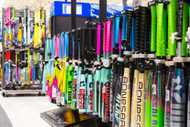
If you have ever stood in front of a wall of youth baseball bats holding your phone in one hand and a confused ten-year-old in the other, you are in very good company. Between USA, USSSA, and BBCOR stamps, drop weights, barrel sizes, and price tags that can make your eyes water, buying a bat has quietly become one of the more stressful parts of youth baseball. And here in Wisconsin, the pressure is real. The season is short, the summer is precious, and nobody wants to waste a Saturday driving home with the wrong bat.
We have been helping Milwaukee-area families sort this out since 1881. So take a breath. Here is how we walk parents through it at the counter.
Start with one question: what does the league require?
Before length, before weight, before your kid's very strong opinion about the color, there is a single question that rules out about 80% of choices. What does your league allow?
There are three stamps that matter, and a bat is only legal if it has the right one:
- USA Baseball (USABat) is the stamp for most rec leagues, including Little League. These bats are built to hit like wood.
- USSSA (1.15 BPF) is the "thumbprint" stamp for most travel and select teams. More pop, more exit velocity.
- BBCOR is required for high school and college, and every one of these is a drop -3.
Check your league's rulebook or ask your coach, and you have just narrowed the whole wall down to one section. If you are not sure, bring the league name in with you and we will figure it out together.
The 2026 change that's catching families off guard
Here is the one a lot of parents do not see coming. As of January 1, 2026, USSSA moved 14U from a drop -5 to BBCOR (-3) or wood as the national standard. In plain English: if your player is aging out of 13U into 14U this year, that trusty travel bat probably is not legal anymore, and you are likely shopping for a BBCOR in a 31 or 32 inch.
It is the kind of rule change that turns into a frustrating text from the dugout if you find out on game day. A few states still allow some limited -5 events, so double-check your specific tournaments. But plan on BBCOR and you will not get caught off guard.
"Drop weight" is simpler than it sounds
Drop weight is just the length minus the weight. A 30-inch bat that weighs 20 ounces is a "-10." The bigger the number, the lighter and easier it is to swing fast. The smaller the number, the more it weighs and the more power it can deliver once your player is strong enough to handle it.
The mistake we see most often? Going too heavy too soon because a bat "looks like the big kids' bat." A bat your player can whip through the zone with control will almost always beat a heavier one they have to muscle around. Bat speed wins.
Getting the size right (the quick version)
A good starting point is your player's height:
- Around 4 feet tall: a 28 to 29 inch bat
- 4'5" to 4'8": a 29 to 30 inch bat
- 5 feet even: a 30 to 31 inch bat
- 5'5" and up: a 32 inch bat, give or take
Two tests we do right in the store. First, stand the bat next to their leg. If their fingertips reach the handle, the length is close. Then have them hold it straight out to the side for a slow count to twenty. If the barrel starts dipping toward the floor, it is too heavy. Simple, and it saves a lot of guesswork.
Try before you buy at the Burghardt Demo House
Here is the part you cannot get online. Inside our batting cages we run the Demo House, a free bat-and-helmet borrow station. Your player can grab a bat, step into a tunnel, and take real cuts before you commit to anything. With a bunch of different sizes and drops to try, it is easy to find the bat of their dreams.
The cages are walk-in, no reservations, on our Cage Card system, and our HitTrax tunnel puts exit velocity and launch angle right on the screen. So instead of guessing whether the 31 or the 32 feels better, you can see it. Two bats that look identical on paper can feel completely different in a kid's hands, and ten minutes in the cage tells you more than any spec sheet.
When it's time to retire the old one
Bats do not last forever. Trade up when you see cracks or dents, hear a rattle, feel a stinging vibration on contact, or notice the pop just is not there anymore. Composite bats especially fade with heavy use. And of course, most players size up a bat, or jump a certification like that 13U-to-14U BBCOR move, every season or two as they grow.
If you are not sure whether a bat is done, bring it in. We will take a look and tell you straight. Sometimes it has got another season in it, and sometimes it is time.
Come see us
We are a family business, and we treat the bat decision the way we would want someone to treat it for our own kids. No pushing you toward something your player cannot swing, no rushing. Just honest advice, a deep selection of USA, USSSA, and BBCOR bats, and our in store cages to prove it. When you love baseball like we do, you can't beat Burghardt.
Burghardt Sporting Goods
15333 W National Avenue, New Berlin, WI 53151
Phone: (262) 790-1170
Mon–Fri 9 AM–9 PM, Sat 9 AM–7 PM, Sun 10 AM–6 PM
Swing by, bring the league name, and let's find the one that feels right.