
Indoor Soccer Gear: What Players Need | BSG
Posted by Burghardt Sporting Goods on Oct 13th 2026
What Soccer Gear Does a Player Need for Indoor Season?
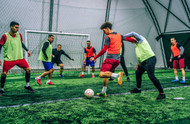
Wisconsin soccer moves indoors for the winter. Both the shoes and the ball have to change.
Quick answer: Indoor soccer calls for flat, non-marking shoes in place of cleats, shin guards that carry the NOCSAE seal, socks tall enough to cover those guards, and whatever ball the league plays with. Futsal, played on a hard court, uses a size 4 ball with a dampened bounce. Outdoor youth sizes follow the US Youth Soccer version of Law 2: size 3 at U8 and younger, size 4 at U10 and U12, size 5 from U13 up. Molded studs get turned away from most hardwood, and some turf buildings have their own shoe rule, so confirm the surface before buying. Burghardt Sporting Goods, 15333 W National Avenue, New Berlin, WI 53151, (262) 790-1170, stocks soccer footwear, balls, shin guards, and goalie gear, open Mon–Fri 9 AM–9 PM, Sat 9 AM–7 PM, Sun 10 AM–6 PM.
What does a soccer player need for indoor season?
The list is short, and most of it is already in the bag from the outdoor season. What changes is the footwear and, in a futsal league, the ball.
- Flat, non-marking indoor shoes for hardwood or sport tile, or turf shoes if the facility runs on artificial turf.
- Shin guards sized to the player's leg, carrying the NOCSAE seal.
- Socks tall enough to cover the guards fully.
- The ball the league plays with, which in futsal is a size 4 with a reduced bounce.
- A hand pump, a needle, and a cheap pressure gauge.
- Goalkeeper gloves and padded pants for anybody playing keeper on a hard floor.
For the full outdoor-season list across spring sports, our spring sports essentials post covers cleats, sticks, and bats by sport.
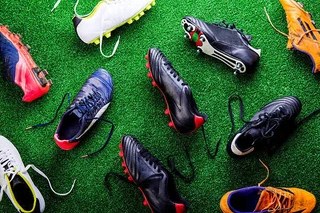
What is the difference between indoor, turf, and firm ground soccer shoes?
The outsole is the whole difference, and it decides which floors will let the shoe in the door.
| Shoe type | Outsole | Built for | Why it matters |
|---|---|---|---|
| Indoor (IN or IC) | Flat, non-marking gum rubber | Hardwood, sport tile, futsal courts | Grips a hard floor without leaving marks on it |
| Turf (TF) | Dozens of short rubber nubs | Artificial turf, including older carpet-style indoor fields | Spreads the load with no studs to catch in the fibers |
| Firm ground (FG) | Molded plastic or rubber studs | Natural grass outdoors | Studs bite into grass and skate on a gym floor |
| Soft ground (SG) | Fewer, longer studs, often removable | Wet, soft natural grass | Too aggressive for any indoor surface |
Modern long-pile turf buildings sometimes allow firm ground shoes, and plenty of them do not. Call the facility before the first session rather than finding out at the door. Indoor shoes and turf shoes both live in our soccer footwear selection, and the staff will put a player through a few cuts in the aisle before you decide.
What size soccer ball should my child use?
Ball size follows age group. US Youth Soccer publishes the Laws of the Game as it modifies them for youth play, and those modifications set the size for each age bracket.
| Age group | Ball size | Common use |
|---|---|---|
| U6 and U8 | Size 3 | Small-sided outdoor play, youth futsal at the youngest ages |
| U10 and U12 | Size 4 | Outdoor play, and the futsal size for older groups |
| U13 and older | Size 5 | Full-field outdoor play, high school, adult |
A size 5 ball under Law 2 measures 68 to 70 cm around, weighs 410 to 450 g at kickoff, and holds 8.5 to 15.6 pounds per square inch at sea level. Leagues can modify any of this, so the rulebook wins. High school game balls carry the NFHS Authenticating Mark, which is why the game-ball models list NFHS right in the product name. Practice balls need no mark. Browse soccer balls if you already know the size the league uses.
Is a futsal ball different from a regular soccer ball?
Yes, and the difference is in the bounce. A futsal ball is built with a dampened bladder so it stays near the floor instead of springing off a hard court. Under the FIFA Futsal Laws of the Game, the adult ball is a size 4, and youth futsal programs commonly put the smallest age groups on a size 3. The heavier feel relative to its size is deliberate, since it rewards touch and keeps the game on the ground.
An outdoor size 5 on a gym floor bounces well over a young player's head on the first heavy touch. If the league says futsal, buy the futsal ball.
Do indoor leagues require shin guards?
Most do, and high school soccer requires them outright. Under National Federation of State High School Associations (NFHS) rules, which the Wisconsin Interscholastic Athletic Association (WIAA) plays under, shin guards have to be professionally manufactured, meet the NOCSAE standard, and carry the NOCSAE seal permanently marked on the guard itself. They have to suit the player's age and size, they cannot be altered in any way that cuts protection, they cannot sit more than two inches above the ankle, and they are not worn on the side of the leg.
Jewelry is not permitted during play. Religious and medical alert items are handled separately and taped. Sizing is by leg length more than by shoe size, so a guard that reaches from about two inches below the knee to the top of the boot is the target. Our shin guards run from youth slip-ins through full guards with ankle protection.
What does a goalkeeper need for indoor play?
Hard floors are rougher on a keeper than grass is. Gloves with a grippy latex palm still do the job, and many keepers prefer a thinner palm indoors for touch on a faster surface. Padded pants or long padded tights matter more than they do outdoors, because the floor gives nothing back when a keeper lands on a hip. Long sleeves save forearms. Keepers follow the same footwear rule as everyone else on the floor. Goalie gear and soccer apparel are both on the floor in New Berlin.
How much air should a soccer ball have in a cold garage?
Law 2 puts a match ball between 8.5 and 15.6 pounds per square inch at sea level. Cold air reads lower on a gauge, so a ball stored in an unheated garage comes inside feeling flat and then reads normal once it warms up. Check the pressure at room temperature. Pumping a cold ball up to a warm-weather number overinflates it the moment it warms, which is how seams and bladders give out early. Keeping one ball in the house through the winter solves the problem for the price of nothing.
Where can you buy indoor soccer gear near Milwaukee?
Burghardt Sporting Goods has outfitted Wisconsin athletes from New Berlin since 1881. Soccer footwear, balls, shin guards, goalie gear, and team uniforms all run out of the same building at 15333 W National Avenue, and decoration is done in house, so a club that needs numbered indoor warmups is not waiting on an outside shop. We work with hundreds of teams across Wisconsin. The store is about 15 minutes from downtown Waukesha and 20 from Milwaukee's west side.
Burghardt Sporting Goods
15333 W National Avenue, New Berlin, WI 53151
Phone: (262) 790-1170
Hours: Mon–Fri 9 AM–9 PM, Sat 9 AM–7 PM, Sun 10 AM–6 PM
Family owned in Wisconsin since 1881
Frequently asked questions
Can my kid just wear outdoor cleats indoors?
On hardwood, no. Molded studs slide on a finished floor and scuff it, and most buildings will stop a player at the door. On artificial turf it depends on the facility and the age of the surface, so ask them directly. Wearing grass cleats on concrete or tile also kills the studs fast, since there is nothing for them to sink into.
Do we need separate shoes for turf and hardwood?
If the player trains on both all winter, two pairs is the honest answer. A turf shoe on hardwood gives up grip and wears the nubs flat. A flat indoor shoe on turf slips because nothing holds in the fibers. Plenty of families pick the surface their player sees most and live with the compromise on the other one.
What size shin guards should I buy?
Measure the leg, not the shoe. A guard should start about two inches below the knee and end at the top of the boot, with no gap of bare shin above the sock line. Slip-in guards suit younger players who already wear socks tall enough to hold them. Guards with built-in or removable ankle protection are worth it for players new to the game, since early contact tends to land low.
Is a futsal ball worth buying if the league uses a regular ball?
For gym-floor skill work, many coaches like it anyway. The lower bounce forces the player to keep the ball under the foot instead of chasing it off a hard surface. If the league plays with a regular ball, train with both and bring the league ball to games.
Does high school soccer play indoors in Wisconsin?
No. The WIAA runs boys soccer as a fall sport and girls soccer in the spring, with the earliest girls practice date for the 2027 season set at March 22, 2027. Winter soccer in Wisconsin is club, futsal, open-gym work, and whatever a player does on their own. That gap is the subject of our companion post, where a Wisconsin soccer player spends the winter.
How long do indoor soccer shoes last on a growing foot?
Growth usually ends it before wear does. Check fit at the start of winter and again around the new year, since a young foot can move half a size in a few months. On the shoe itself, watch the forefoot: once the gum rubber polishes smooth where the player plants, grip is gone no matter how clean the upper looks.
Ball dimensions, weight, and pressure come from the IFAB Laws of the Game, Law 2. Youth ball sizes by age group come from the Laws of the Game as modified by US Youth Soccer. Shin guard and jewelry requirements come from the NFHS soccer rules; the WIAA plays under NFHS rules and publishes its own season dates each year. The size 4 futsal ball comes from the FIFA Futsal Laws of the Game. Club and indoor league rules vary, so confirm with your league and your facility before ordering. Planning the whole winter? Read the companion post, Where a Wisconsin Soccer Player Spends the Winter.