
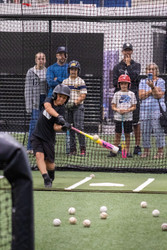
Why Use an Indoor Batting Cage in Winter?
Posted by Burghardt Sporting Goods on Sep 22nd 2026
Why Should My Child Use an Indoor Batting Cage in Winter?
Wisconsin winters are long. Here is what indoor batting cage time does for a young hitter.
Quick answer: A young hitter should use an indoor batting cage in winter because the swing is a timing skill that fades without repetition, and in Wisconsin the outdoor gap runs from roughly October to late March. Indoor cage work keeps bat speed, pitch tracking, and contact quality from sliding while the arm rests, which is what MLB and USA Baseball's Pitch Smart guidelines ask young pitchers to do anyway. A heated tunnel also protects the bat, since bat makers warn against swinging composite barrels below about 60 degrees. Burghardt Sporting Goods, 15333 W National Avenue, New Berlin, WI 53151, (262) 790-1170, runs four indoor tunnels that are walk-in with no reservations, three standard and one HitTrax, at $2 per 15-pitch round.
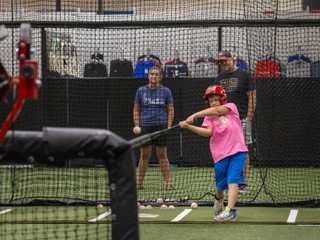
What does winter cage time actually hold onto?
Hitting is a timing skill. The swing depends on the eyes, the hands, and the lower half arriving in the same order every time, and that sequence decays when a player stops doing it. Four or five months away from live pitching means a hitter spends the first weeks of spring rebuilding what they already had in July. Regular indoor rounds keep pitch recognition, bat speed, and clean contact in working order, so March practice starts from where the season ended rather than from scratch. Cage reps are also the most concentrated hitting work available, because nothing else is competing for the time.
How long is the baseball off-season in Wisconsin?
Longer than most states. Youth and travel seasons around Milwaukee wrap up in the fall, and the Wisconsin Interscholastic Athletic Association (WIAA) does not open spring baseball practice until late March. The 2026 earliest practice date was March 23, with a pitcher instruction window the week before. That leaves a stretch of roughly five months with no organized outdoor hitting, running through the coldest part of the year. Indoor facilities are the only reliable place to swing a bat in that window.
How often should a young hitter go to the cage in winter?
Once a week is enough to hold a swing together, and twice a week is enough to improve it. Consistency beats volume here. A single 30-minute session of four or five focused rounds, repeated weekly from December through February, will do more than one marathon session in January. For how to structure the rounds themselves, see our post on making batting cage time count.
Should a young player throw over the winter too?
No, not at full effort. Pitch Smart, the joint MLB and USA Baseball program on youth arm health, recommends that pitchers take at least four months off from competitive pitching each year, including two to three continuous months with no overhead throwing at all. Winter is the natural place for that rest in a northern state. That is exactly why hitting is the right winter focus: a player can keep developing without asking anything of the throwing arm. Light catch and general conditioning are separate questions for a coach or a physician.
Is an indoor cage better than hitting in a garage or driveway?
For a Wisconsin winter, yes. A heated tunnel delivers a consistent live pitch at a set speed, which a tee or soft toss in the garage cannot replicate, and it keeps the bat out of the cold. That second part carries real money with it. Bat manufacturers advise against using composite bats in cold weather, and DeMarini's non-wood bat warranty guidance flags temperatures under 60 degrees as a damage risk, because cold hardens the ball and makes the barrel more likely to crack. Warranty coverage often excludes damage from cold-weather use, so a cracked barrel in an unheated garage becomes the family's problem.
| Winter hitting option | Temperature | Live pitching | Feedback | Risk to the bat |
|---|---|---|---|---|
| Heated indoor tunnel | Room temperature all winter | Yes, machine at set speeds | Immediate, and measured in a HitTrax tunnel | Low |
| Garage or basement net | Often below 60 degrees | Tee and soft toss only | Feel only | Higher in an unheated space |
| Driveway or outdoor field | Whatever the day gives you | Rarely | Feel only | High in cold weather |
| Nothing until spring | Not applicable | No | None | None, and no development either |
What does an indoor cage session cost?
At Burghardt, cage time runs on the BSG Cage Card system rather than a clock. One credit is $2 and buys one round of 15 pitches in a standard tunnel. A HitTrax round is two credits, or $4, and returns exit velocity, launch angle, and projected distance for every ball hit. Credits can be bought individually or in a 20-credit pack for $30. Cards are loaded on the Cage Credits page or at the counter.
What is HitTrax and is it worth the extra credit in winter?
HitTrax is a ball-tracking simulator that reads the ball off the bat and puts the numbers on a screen. In the winter months it answers the question a hitter cannot answer from feel alone, which is whether an adjustment made in December is still holding in February. One HitTrax round at the end of a session is usually enough to track progress across a winter. Full detail lives in our HitTrax explainer.
Where can you hit indoors near Milwaukee in winter?
Burghardt Sporting Goods runs four indoor batting tunnels at 15333 W National Avenue in New Berlin, about 15 miles west of downtown Milwaukee. Three are standard tunnels with four selectable pitch speeds for baseball and softball, and the fourth is the HitTrax tunnel. All four are walk-in with no reservations, so a family can stop in any time the store is open. The batting cages page has the facility details. A separate 7,500 square foot indoor turf area handles full team practices and is reservation-based.
Burghardt Sporting Goods
15333 W National Avenue, New Berlin, WI 53151
Phone: (262) 790-1170
Hours: Mon–Fri 9 AM–9 PM, Sat 9 AM–7 PM, Sun 10 AM–6 PM
Cages: walk-in, no reservations, on the BSG Cage Card system
Frequently asked questions
What age can a kid start using an indoor batting cage?
Any age that can safely hold a bat and wear a helmet. The standard tunnels offer four pitch speeds, so a seven-year-old and a high school senior can both find a workable setting. Younger hitters should have an adult with them in the tunnel area.
Do you need a reservation for a batting cage at Burghardt?
No. All four tunnels are walk-in with no reservations. Load credits onto a BSG Cage Card and swipe in whenever the store is open. The 7,500 square foot indoor turf is the reservation-based space, which is a different part of the Performance Center.
Can a softball player use the same winter cages?
Yes. The standard tunnels pitch both baseball and softball at four speeds, and the HitTrax tunnel tracks both. Fastpitch hitters use the same Cage Card and the same credits.
Do you have to own a bat to hit in the cages?
No. The Demo House sits inside the cage area at Burghardt and lends bats and helmets free of charge, so a player can take real winter cuts with a bat before deciding whether to buy it. Winter is a common time for a growing hitter to move up a size.
Is it bad to use a composite bat in cold weather?
Manufacturers say yes. Cold weather hardens the ball and makes composite barrels more likely to crack, and DeMarini's non-wood bat warranty guidance calls out temperatures below 60 degrees as a damage risk. Warranty coverage often excludes cold-weather damage. A heated indoor tunnel avoids the problem entirely.
How much does a winter of cage time cost?
At $2 per standard round, a weekly session of four rounds runs $8, or roughly $100 across a December to February stretch. A 20-credit pack is $30, which covers five weekly visits of four standard rounds each. HitTrax rounds are two credits.
Arm rest recommendations come from Pitch Smart, the youth pitching program run jointly by MLB and USA Baseball. Wisconsin high school season dates come from the WIAA and change each year. Cold-weather bat guidance comes from bat manufacturer warranty documentation. Confirm current rules with your league or athletic director, and check individual bat warranty terms with the manufacturer. Planning a full winter around the cages? Read the companion post, A Wisconsin Hitter's Winter Plan, November to Opening Day.